Buy on Amazon
As an Amazon Associate I earn from qualifying purchases.
How to Choose a Handheld Steam Cleaner: A Practical Guide to Cleaning Kitchens, Bathrooms, Upholstery, and More
Keeping a home clean often means dealing with several types of mess. Kitchen surfaces collect grease, bathroom tiles develop soap residue, window glass shows fingerprints, and upholstered furniture can accumulate everyday dirt. Using a different cleaning tool for every task can take up storage space and make household cleaning feel more complicated than it needs to be.
A handheld steam cleaner offers another approach. It heats water and releases hot steam through an attachment designed for a particular cleaning task. Depending on the machine and the surface, steam may help loosen grime and make some cleaning jobs easier without requiring a cleaning chemical in the water tank.
However, steam cleaning is not suitable for every material. High temperatures, moisture, and pressure can damage delicate finishes, flooring, fabrics, and heat-sensitive plastics. A product described as suitable for multiple surfaces should therefore be evaluated against the actual care instructions for the items you intend to clean.
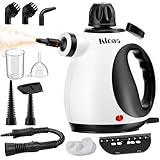
The KLONA Handheld Steam Cleaner is advertised as a compact home-cleaning appliance with a 1050W heating system, 3.2-bar pressure specification, a claimed steam temperature of 221°F (105°C), and a 350ml water tank. The listing recommends filling the tank with approximately 250ml of water, advertises a heat-up time of around three minutes, and describes continuous operating time of ten minutes or more. It also includes a 10-piece accessory set and features such as a safety lock, safety cap, and 9.4-foot power cord.
These specifications may make the product worth considering for household cleaning, but the most suitable steam cleaner depends on the jobs you need to complete, the surfaces in your home, and the safety features and instructions provided with the actual appliance.
What Is a Handheld Steam Cleaner?
A handheld steam cleaner is a portable appliance that heats water and directs steam through a nozzle or attachment. Instead of relying entirely on a liquid cleaning solution, it uses heat and moisture to help loosen certain types of dirt and residue.
The attachment influences how the steam is applied. A narrow nozzle can direct steam toward a small area, a brush attachment provides a contact surface for suitable cleaning jobs, and a window tool may help with compatible glass surfaces.
This flexibility can be useful when cleaning around taps, tile joints, sink edges, or other areas that are difficult to reach with a large mop or cloth. A handheld body can also be easier to carry between rooms than a larger floor-cleaning machine.
However, a steam cleaner is not a replacement for every cleaning tool. It may not be suitable for large floors, every type of upholstery, or materials that cannot tolerate concentrated heat and moisture. Dirt may still need to be wiped away, and some jobs require ordinary detergent, a soft cloth, or a specialised cleaning method.
Before purchasing, identify two or three tasks you expect to perform regularly. A cleaner that works well for those particular jobs may offer more practical value than one advertised for an extremely broad range of applications.
Understanding the KLONA Steam Cleaner Specifications
The KLONA handheld steam cleaner is advertised with several features intended to support household use.
| Advertised feature | What it means for everyday use |
|---|---|
| 1050W power | Indicates the rated electrical power of the appliance. |
| 3.2-bar specification | An advertised pressure figure; confirm whether the manufacturer identifies this as operating or maximum pressure. |
| 221°F (105°C) steam | The seller's stated steam-temperature claim. Actual temperatures may vary by measurement point and operating conditions. |
| 350ml tank | The stated water-tank capacity. |
| Approximately 250ml recommended fill | Leaves space in the tank according to the listing's instructions. |
| Approximately 3-minute heat-up | The seller's advertised heating time, which may vary with conditions. |
| 10 minutes or more of operation | The advertised running time; actual duration may vary with steam output and use. |
| 9.4-foot (3m) cord | Provides some flexibility when working near a suitable electrical outlet. |
| 10-piece accessory set | Provides attachments for different advertised cleaning tasks; confirm the exact items supplied. |
These figures provide a useful starting point for comparison, but they do not independently establish cleaning performance, exact pressure during use, or how long the unit will produce steam under every setting and condition.
For example, the 350ml tank capacity is not the same as the recommended fill amount. The supplied listing specifically recommends approximately 250ml, so the appliance should be filled according to its instructions rather than filled to capacity simply because space remains.
Similarly, the advertised heat-up and running times should be treated as estimates. Your experience may differ depending on the water level, room conditions, and how continuously steam is released.
Steam Temperature and Pressure: What to Understand Before Buying
The listing describes a steam temperature of 221°F (105°C) and a pressure specification of 3.2 bar. These figures are intended to communicate the appliance's steam output and operating characteristics.
Temperature and pressure are relevant to how a steam cleaner functions, but higher numbers do not automatically mean better results for every job. A surface that can tolerate hot steam may benefit from careful application, while a delicate surface can be damaged by the same heat and moisture.
The supplied information does not establish the precise measurement conditions for the listed temperature or clarify whether 3.2 bar refers to maximum pressure or operating pressure. Check the manufacturer's instructions for those details rather than assuming that either number describes every moment of operation.
High-temperature steam can also cause burns. Never point the nozzle toward yourself, another person, or an animal. Keep hands away from the steam outlet, and take extra care when changing attachments because parts may remain hot after use.
Most importantly, do not open the water-tank safety cap while the appliance is hot or pressurised. Follow the manufacturer's shutdown, pressure-release, and cooling procedure before refilling the tank or removing any cap.
The 350ml Water Tank and Recommended 250ml Fill
Tank capacity affects how much water an appliance can hold between refills. The KLONA listing identifies a 350ml tank but recommends using approximately 250ml of water to leave space for normal operation.
This distinction matters because pressurised steam appliances may require space within the tank for proper operation. Filling beyond the manufacturer's recommended level can create an avoidable safety risk.
A compact tank may suit short household tasks, such as cleaning around a sink, treating a small tile area, or working on several confined spots. However, it may require more frequent refilling than a larger appliance when cleaning extensive surfaces.
The useful question is not simply how many millilitres the tank holds. Consider how much area you expect to clean in one session and how often you are willing to stop, shut down the appliance, and wait for it to become safe to refill.
Do not refill a hot or pressurised tank just to continue cleaning more quickly. Follow the exact instructions provided with the unit, including any required cooling and pressure-release steps.
What Can the Accessory Kit Help You Clean?
The KLONA cleaner is advertised with a 10-piece accessory set. The supplied description names several attachments, including an angled nozzle, a bendable extension, a brush nozzle, a fabric-steaming tool, and a rubber wiper for windows or doors. It does not identify every piece in detail, so check the package contents before purchasing.
Different attachments can make a handheld cleaner more adaptable, but an attachment should only be used on surfaces permitted by the manufacturer's instructions.
Angled nozzle for narrow areas
An angled nozzle may help direct steam toward accessible corners or around suitable fixtures. This can be useful when a straight nozzle is awkward to position.
Use it carefully. Concentrated steam can become difficult to control in tight spaces, and directing it toward an electrical component, delicate seal, or hidden adhesive may cause damage.
Brush attachment for suitable hard surfaces
A brush nozzle may provide a way to work on compatible, durable surfaces where grime needs gentle mechanical agitation as well as steam.
The surface matters more than the presence of a brush attachment. Abrasive contact combined with heat may mark a finish, so avoid using the brush on delicate coatings or polished materials unless the instructions specifically allow it.
Flexible extension for difficult-to-reach spots
A bendable extension may provide extra reach or help position the nozzle around suitable fixtures. It can reduce the need to hold the main body in an awkward position.
Before use, confirm that the extension is designed for the appliance and that it is securely fitted. Do not assume that a flexible attachment permits steam to be directed safely into any cavity or enclosed space.
Fabric-steaming attachment
The listing includes a fabric-steaming tool. Such an attachment may be useful for compatible textiles, but fabric care requirements vary widely.
Before treating curtains, upholstery, or clothing, check the fabric's care label and the steam cleaner's instructions. Test an inconspicuous area when permitted, allow it to dry, and inspect for colour changes, shrinkage, water marks, or texture changes.
Leather, suede, silk, velvet, delicate decorative trims, and fabrics with heat-sensitive finishes can be damaged by steam. Do not use the attachment on them unless both the appliance instructions and the material's care guidance explicitly permit it.
Window and door wiper
A rubber wiper may help remove moisture and loosened residue from compatible glass. However, sudden temperature changes can crack some glass, particularly when it is very cold or already damaged.
Check the instructions before cleaning windows or mirrors, avoid applying hot steam to cold glass, and never use a tool on cracked glass.
The exact intended surfaces and use method should always be confirmed for each accessory. Having several attachments increases flexibility, but it does not make all materials suitable for steam cleaning.
Kitchen Cleaning: Grease, Sinks, and Hard Surfaces
Kitchens can collect cooking residue around taps, sink edges, backsplashes, and other frequently used areas. A handheld steam cleaner may help loosen certain residues from compatible, heat-resistant surfaces.
The KLONA listing specifically mentions stoves and barbecue grills among possible uses. Before using steam around either, make sure the appliance or grill is completely switched off, disconnected from power where appropriate, and cool enough to handle safely. Steam must never be directed into powered electrical components or equipment that contains exposed electrical parts.
Heavy, burnt-on, or thick grease may not disappear with one pass. Depending on the material, residue may still need to be wiped away or treated using a suitable cleaning method. Avoid assuming that steam alone removes every type of kitchen dirt.
For food-contact surfaces, check the care instructions for the surface and the cleaning appliance. After cleaning, follow any required wiping or rinsing guidance. Do not assume that steam cleaning automatically sanitises a surface to a particular standard, because that depends on contact conditions and the applicable cleaning requirements.
Bathroom Tiles, Sinks, and Shower Areas
Bathrooms often have hard, moisture-resistant surfaces that may be suitable for steam cleaning when their manufacturers permit it. Compatible ceramic tiles, sink surfaces, and some fixtures may be candidates for targeted cleaning.
A narrow nozzle can help direct steam toward accessible corners and around suitable fixtures. A brush attachment may provide additional mechanical action when the surface can tolerate it.
However, grout, sealants, adhesives, coatings, and surrounding materials may respond differently to heat and moisture than the main tile surface. Excessive steam or prolonged exposure can damage some finishes even when the tile itself is durable.
Before beginning, check the surface manufacturer's guidance, test an inconspicuous area when appropriate, and avoid holding the nozzle in one place for a long period.
Steam cleaning should also not be confused with a guaranteed mould-removal or disinfection treatment. Visible mould, persistent moisture, and recurring bathroom stains may require a more targeted approach that addresses the underlying moisture source.
Windows, Furniture, and Upholstery
The product listing presents the cleaner as suitable for windows, sofas, car seats, and other materials. These applications require particular caution because they involve surfaces with very different heat and moisture tolerances.
Glass may crack when exposed to rapid temperature changes. Upholstery can shrink, become marked, or lose colour, while furniture coatings and adhesives may soften under heat and moisture.
Before cleaning a sofa or car seat, identify the exact material and consult its care instructions. If steam is permitted, test a hidden area and allow it to dry fully before continuing. Stop if you notice colour transfer, texture changes, unusual odours, or other signs of damage.
Do not use a broad “suitable for upholstery” description as proof that the tool is appropriate for every fabric. The fabric, backing, padding, adhesive, and finish may all affect whether steam cleaning is suitable.
For windows and mirrors, begin only when the glass is in a suitable temperature condition, avoid damaged glass, and follow the instructions for the wiper attachment.
Is Steam Cleaning Truly Chemical-Free?
The KLONA listing describes the appliance as a natural cleaning option that does not produce harmful fumes or residue from cleaning chemicals. A steam cleaner can operate using water rather than a detergent in its tank, which may appeal to households trying to reduce the number of cleaning products they use.
However, “chemical-free” is an imprecise marketing phrase. Water and steam are themselves chemical substances, and the absence of added detergent does not make hot steam harmless. High-temperature steam can still burn skin, damage materials, and create hazards if handled incorrectly.
Steam also does not eliminate every cleaning requirement. Some stains and residues may need additional treatment, while some surfaces should not be exposed to steam at all.
Do not add cleaning agents, fragrances, disinfectants, or other substances to the water tank unless the manufacturer explicitly permits them. Unapproved additives can damage the appliance or create additional risks.
A more useful way to evaluate this feature is to ask whether water-only cleaning is suitable for the jobs you plan to do, rather than assuming that a chemical-free claim guarantees complete cleaning or universal safety.
Safety Lock, Safety Cap, and Household Use
The listing describes a safety lock on the handle and a safety cap. These features are intended to support safer operation, but they do not remove the need to follow the appliance instructions.
A safety lock may help prevent unintended activation, depending on its design. The safety cap is part of the tank's pressure-management system. Neither should be treated as permission to handle the appliance casually while it is hot.
Keep children and pets away from the cleaning area while steam is being released. Do not direct steam toward toys, pet equipment, food containers, or other items merely because they appear sturdy. Check the materials and care instructions first, especially for heat-sensitive plastics.
After use, switch off and unplug the appliance as directed. Follow the manufacturer's procedure for releasing pressure and allowing the tank to cool. Never force a cap open, and do not remove an attachment while hot steam could escape toward your hands.
Also keep the power cord away from hot surfaces, sharp edges, water, and walking paths. The advertised 9.4-foot (3m) cord offers some reach, but it does not eliminate the need to use the appliance near a suitable electrical supply and in accordance with its instructions.
Potential Advantages
Portable handheld design
A compact form may be convenient for moving between rooms and cleaning confined areas without bringing out a larger appliance.
Multiple attachments
The advertised 10-piece accessory set may provide options for suitable hard surfaces, narrow spaces, and compatible fabrics. The exact kit contents and intended use of each accessory should be confirmed.
Water-based cleaning
Operating with water rather than adding cleaning chemicals to the tank may appeal to people who want a simpler cleaning method for appropriate surfaces.
Stated heating and power specifications
The advertised 1050W rating and approximately three-minute heat-up time give shoppers a starting point for comparison. Actual heating time may vary, and the product claims should not be treated as independently verified performance figures.
Safety features listed by the seller
The handle lock and safety cap are useful features to examine when comparing steam appliances. Safe use still depends on the complete design, proper handling, and the supplied instructions.
Corded operation
The 9.4-foot (3m) cord can provide some movement around a room without relying on a rechargeable battery. The available reach will depend on outlet location and the cleaning task.
Things to Consider Before Buying
Not every surface is steam-safe
Unsealed or moisture-sensitive wood, some laminate and resilient flooring, painted or waxed surfaces, and delicate fabrics may be damaged by heat and moisture. Always check the care instructions for the particular material rather than relying on a general compatibility list.
The pressure and temperature details need context
The listing specifies 3.2 bar and 105°C, but the supplied description does not clarify every measurement condition. Check the manufacturer's documentation for the precise operating specifications.
Tank capacity is not the recommended fill amount
The advertised tank holds 350ml, but the listing recommends approximately 250ml. Follow the recommended fill level and never improvise with an overfilled tank.
Accessories do not guarantee universal compatibility
A window wiper, fabric attachment, or brush may be useful for certain surfaces, but each surface must still be suitable for steam.
Operating time may vary
The seller advertises ten minutes or more of continuous operation. Actual results can differ depending on how the appliance releases steam and the conditions of use.
Safety is an ongoing responsibility
Hot steam and pressurised water can cause serious scalds. The safety lock and cap do not replace careful handling, proper cooling, or the manufacturer's pressure-release procedure.
Who May Benefit From This Type of Steam Cleaner?
A handheld steam cleaner may interest people who regularly clean small areas around a kitchen or bathroom and want a portable tool for compatible, heat-resistant surfaces.
The KLONA model may be worth comparing for households that value multiple attachments, a corded design, a compact water tank, and a handle lock. The accessory set may also appeal to people who want one appliance for several specific tasks instead of purchasing a separate tool for every cleaning job.
It may be less suitable for someone who primarily needs to clean large floor areas, delicate furniture, or a home filled with surfaces whose manufacturers prohibit steam cleaning. People who need a verified sanitation performance level should also check for appropriate test data rather than relying on the presence of hot steam alone.
The best purchase depends on the surfaces in your home and the tasks you expect to complete—not simply the number of accessories or the broadest claims in the product description.
A Practical Checklist Before Ordering
Before choosing the KLONA handheld steam cleaner, work through these points:
Identify your main cleaning tasks. Decide whether you mainly need to clean tile, suitable hard surfaces, narrow spaces, or compatible textiles.
Check surface compatibility. Review the care instructions for your floors, furniture, windows, upholstery, and other intended surfaces.
Confirm the complete accessory list. The listing names several attachments but does not provide a detailed description of every piece.
Understand tank filling. The seller recommends approximately 250ml in the 350ml tank; follow the appliance's stated maximum fill level.
Review heating and runtime claims. Treat the three-minute heat-up time and ten-minute-or-more operating time as advertised estimates.
Read the safety instructions. Understand the safety lock, pressure-release procedure, cooling time, and correct way to change attachments.
Plan safe cord placement. Keep the cord away from water, hot surfaces, sharp edges, and walking paths.
Test carefully before cleaning a large area. When the surface and appliance instructions permit, test a small, inconspicuous area and inspect the result after drying.
This checklist can help you focus on suitability and safe operation instead of relying on broad promises about cleaning power.
Frequently Asked Questions
1. How powerful is the KLONA handheld steam cleaner?
The listing specifies 1050W of power and an advertised pressure of 3.2 bar. These figures describe different aspects of the appliance and do not independently establish cleaning effectiveness.
2. How hot does the steam get?
The seller advertises a steam temperature of 221°F (105°C). Actual temperature can vary by location and operating conditions, so consult the manufacturer's documentation for the measurement details.
3. How much water should I add?
Although the listed tank capacity is 350ml, the product description recommends approximately 250ml of water. Follow the instructions supplied with the unit, and never refill it while hot or pressurised.
4. How long does the appliance run on one fill?
The seller advertises continuous operation for ten minutes or more. The actual operating time may differ depending on how the device is used and how continuously steam is released.
5. Can I use it on wooden floors and furniture?
Do not assume that all wood or wood-look surfaces are suitable. Steam can damage unsealed or moisture-sensitive wood, some laminate products, coatings, and adhesives. Check the surface manufacturer's instructions before use.
6. Can it clean sofas and car seats?
The listing advertises upholstery and car-seat cleaning, but suitability depends on the fabric and construction. Check the material's care instructions, test a hidden area when permitted, and stop if you notice discolouration, shrinkage, or other changes.
7. Does steam cleaning guarantee that surfaces are disinfected?
No. The supplied information does not establish a verified disinfection level or contact time for this specific product. Do not treat ordinary steam cleaning as a guarantee of sanitisation.
8. Is it safe to refill the tank immediately after cleaning?
No. Follow the manufacturer's shutdown, pressure-release, and cooling instructions before opening the safety cap or refilling the tank. Never force the cap while pressure may remain inside.
Final Thoughts
A handheld steam cleaner can be a useful addition to a household cleaning routine when its capabilities match the surfaces and tasks involved. Its main appeal is versatility: a portable appliance with suitable attachments may help with selected kitchen, bathroom, and other household cleaning jobs.
The KLONA Handheld Steam Cleaner is advertised with 1050W power, a 3.2-bar pressure specification, a claimed 105°C steam temperature, a 350ml tank with a recommended 250ml fill, a 10-piece accessory set, and a safety lock and cap. The listed heat-up and operating times provide comparison points, but they should be treated as seller claims rather than guaranteed results.
Before buying, prioritise surface compatibility, the exact accessory list, practical tank capacity, and safe pressure handling. Steam can loosen grime on suitable materials, but it can also cause burns and damage surfaces that are not designed to withstand high temperatures and moisture.
The most effective choice is not simply the cleaner with the widest advertised range of uses. It is the one that suits your actual cleaning needs, comes with clear operating instructions, and can be used safely on the materials you intend to clean.
Affiliate Disclosure: As an Amazon Associate I earn from qualifying purchases.


Comments
Comments
Post a Comment